|
||
22. Vermicular Schreibersite |
| Listing of Structures |
| Back...Next |
| Fort Stockton - Iron meteorite, classification not refined. 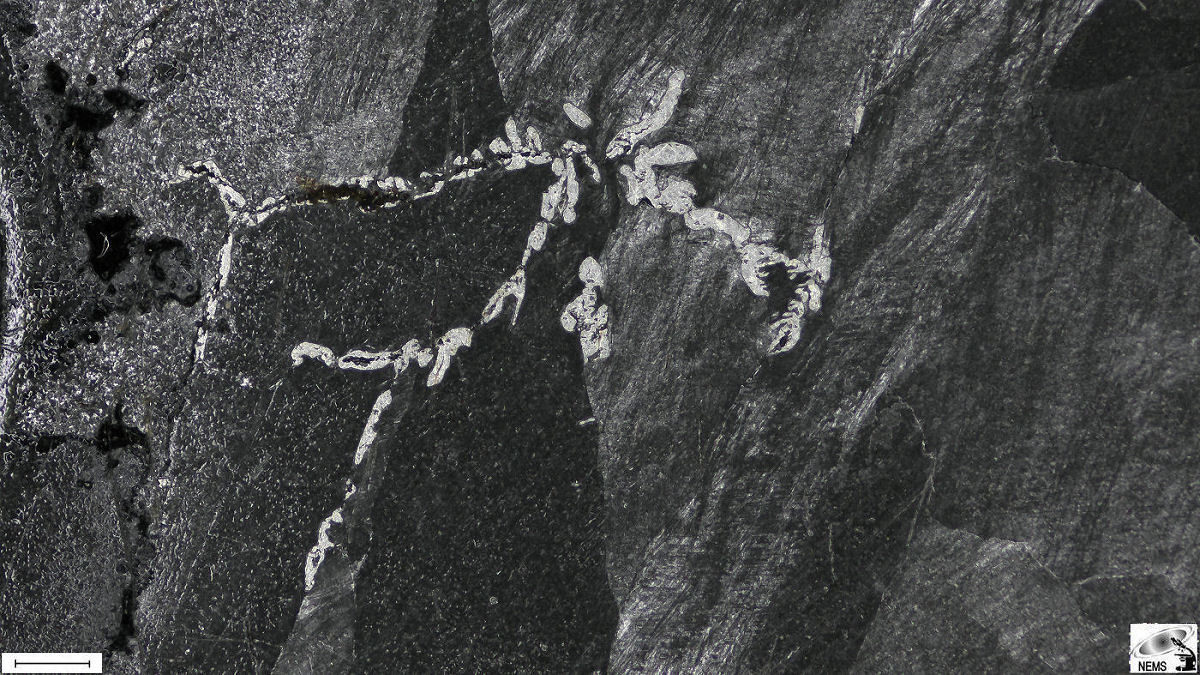 Figure 1 Vermicular schreibersite in the Fort Stockton iron meteorite. Scale bar=400 µm. Mineralogy and Occurrence Schreibersite ((FeNi)3P) is a common accessory phosphide mineral in iron meteorites. It crystallizes from residual P-bearing metal-sulfide melts during the later stages of cooling of differentiated asteroidal cores. The mineral is notable for its high reflectivity and characteristic crystal habits, which range from euhedral prisms (rhabdites) and skeletal forms to irregular blebs and vermicular (worm-like) intergrowths. “Vermicular schreibersite” refers to elongated, sinuous, thread-like or filamentous morphologies that appear as worm-like threads or rounded blebs within the metallic matrix. In the Fort Stockton iron meteorite (Figure 1), these distinctive structures are prominently displayed. Formation Processes Schreibersite nucleation typically occurs late in the cooling sequence, after solidification of the primary Fe-Ni alloys (austenite-γ taenite and α-kamacite exsolution forming the Widmanstätten pattern). As the meteorite cools slowly through the temperature range where phosphorus solubility decreases (~700–500°C), schreibersite precipitates along grain boundaries, kamacite-taenite interfaces, or within kamacite lamellae, where P diffusion is facilitated by chemical gradients. The development of vermicular morphology likely results from: • Diffusion-controlled growth in a constrained metallic host • Minimization of interfacial energy between the phosphide and surrounding kamacite/taenite • Local variations in cooling rate and minor-element concentrations (e.g., Ni, C, S) Prolonged slow cooling allows crystals to extend into irregular, elongated forms rather than compact euhedra. While some vermicular textures may be modified by later shock or annealing, many appear to reflect primary crystallization dynamics. The Fort Stockton Iron Meteorite The Fort Stockton iron was found in 1952 in Texas. Although never formally published in the Meteoritical Bulletin, it holds official status in the database. The main mass resides in the Monnig Collection at Texas Christian University (TCU), Fort Worth, Texas. Its classification remains incompletely refined, but it exhibits classic iron meteorite microstructures, including vermicular schreibersite intergrowths. Broader Significance Vermicular schreibersite provides insights into phosphorus behavior during asteroidal differentiation and the kinetics of subsolidus transformations. Comparative studies across chemical groups help constrain cooling rates, parent-body sizes, and the role of volatiles in core evolution. In some cases, unusual schreibersite morphologies may also record secondary processing such as shock reheating or impact-induced fluid mobilization. Further microchemical mapping and crystallographic analysis would clarify the exact growth mechanisms and any post-formation modifications in specimens like Fort Stockton. |
| References • Buchwald, V. F. (1975). Handbook of Iron Meteorites. University of California Press. (Standard reference for schreibersite textures and iron meteorite mineralogy.) • General meteoritical literature on phosphide minerals (e.g., papers in Meteoritics & Planetary Science and Geochimica et Cosmochimica Acta). • Meteoritical Bulletin Database (for Fort Stockton entry and classification notes). |
| Listing of Structures |